If you’re looking for a powerful way to launch your reading instruction and build a classroom full of engaged, thoughtful readers, Notice and Note Fiction Signposts are a must. I’ve found that introducing these signposts at the very beginning of the school year transforms how my students approach reading—for the better.

What Are the Fiction Signposts?
Created by Kylene Beers and Robert Probst, the Notice and Note Signposts are six key moments that often appear in fiction texts. These moments help students slow down and think deeply about what they’re reading. Here are the six signposts I start with in my third grade classroom:
- Words of the Wiser – When an older or wiser character offers advice.
- Aha Moment- When a character suddenly realizes or understands something
- Again and Again – When something repeats in a story (a phrase, word, or situation).
- Memory Moment – When a character has a flashback or important memory.
- Tough Questions – When a character is struggling with a decision or inner conflict.
- Contrast and Contradictions – When a character acts differently than expected.
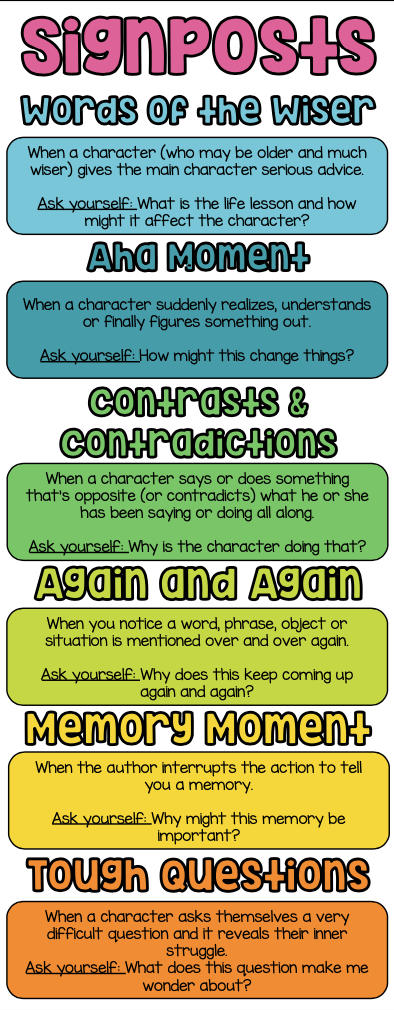
These signposts give students a purpose for reading. They encourage students to pause, ask questions, and dig into the text. Before I teach specific reading standards, I start here—because when students learn to notice these moments, they naturally become stronger readers across all genres and skills.
How I Introduce Signposts
In our first few weeks, we use Pixar shorts to introduce each signpost in an engaging, visual way. The students love it, and they begin to recognize these powerful reading moments without even opening a book. From there, we transition into applying the signposts to our independent reading, book clubs, and read alouds.
By the time we dive into fiction standards, my students are already reading like detectives—spotting patterns, making inferences, and thinking critically. They’re always amazed at how many signposts we find together in our read alouds!
Ready to Try It in Your Classroom?
If you’re excited to get started with signposts, I’ve created a Notice and Note Fiction Signpost Interactive Journal and Bookmarks set that’s perfect for launching this strategy with your students. It includes student-friendly definitions, visual bookmarks, and an interactive journal that helps readers reflect deeply as they read.
👉 Click here to check it out on TPT
And when you’re ready to explore nonfiction signposts, I’ve got you covered there too! My Nonfiction Signpost Bundle includes everything you need to introduce and assess nonfiction signposts with ease: an interactive journal, bookmarks, and a ready-to-use quiz.
👉 View the full Nonfiction Signpost Bundle
👉 Need just the assessment or independent practice? Grab it here.
These resources have helped my students become more intentional, analytical readers—and I hope they’ll do the same for yours!
Mentor Texts & Pixar Shorts for Teaching Signposts
One of my favorite parts of teaching the signposts is introducing them through Pixar-style shorts. These engaging, bite-sized films help students grasp each signpost in a visual and memorable way. Once students understand the concept, we apply it to mentor texts—and they’re always amazed at how much they notice!
Here’s a chart to help you get started:
| Signpost | Short Video Clip | Mentor Texts |
| Words of the Wiser | Boundin’ | Enemy Pie, The Boy Who Cried Wolf, The Giving Tree, A Bad Case of Stripes |
| Contrasts & Contradictions | Finding Nemo – Bruce Scene | Library Lion, Each Kindness, The Bad Seed, Ferdinand, Enemy Pie, A Bad Case of Stripes, Recess Queen |
| Tough Questions | Shoe | A Bad Case of Stripes, A Bike Like Sergio’s, Coal Thief, The Empty Pot |
| Again and Again | Up – Opening Scene | Chrysanthemum, Each Kindness, Where the Wild Things Are, A Sweet Smell of Roses |
| Memory Moment | Tangled – Lantern Scene | A Chair for My Mother, Drawn Together, Fly Away Home, The Day the Crayons Quit |
| Aha Moment | Snack Attack | A Chair for my Mother, Drawn Together, Fly Away Home, The Day the Crayons Quit |
Notice & Note Signposts Task Cards (for independent practice and partner work)

Leave a comment